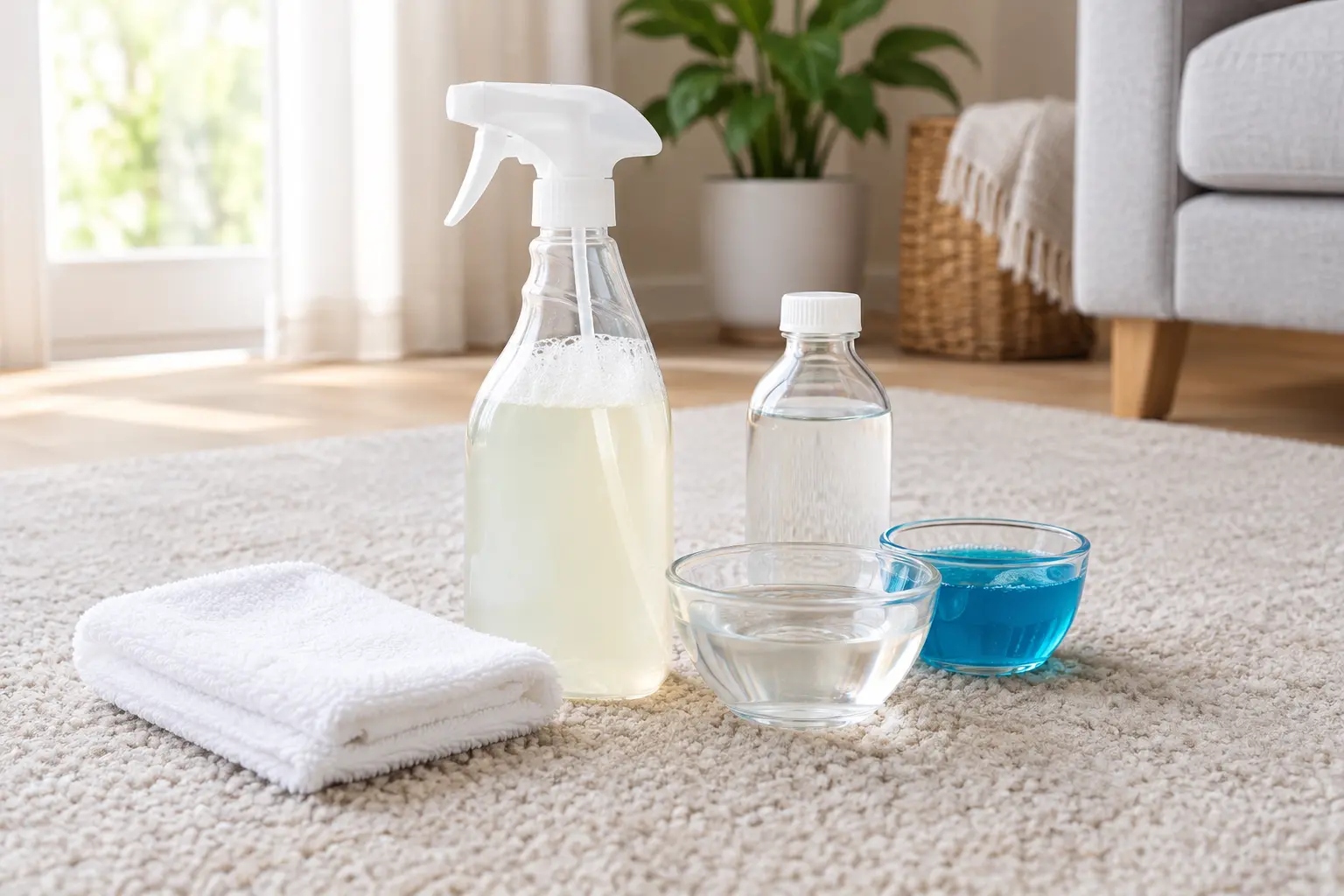
The standard recipe is one gallon of warm water, one tablespoon of clear dish soap, and a quarter cup of distilled white vinegar. Before you pour that into a machine, check the manufacturer’s guidance: vinegar can corrode internal components and void the warranty on many models, including several Bissell machines. Two more things most recipe pages get wrong — mixing vinegar and baking soda together largely cancels both, and too much soap leaves residue that makes the carpet get dirty faster.
Read this before you fill the tank
This is the warning that belongs at the top of every page on this subject and appears on almost none of them.
Carpet cleaner manufacturers position vinegar as a risk: the acid can corrode internal components and degrade rubber seals over time, and running a non-branded solution can void your warranty. Several sources note this applies to many Bissell models specifically.
The honest position, which one long-time DIY writer states plainly: plenty of home users have run diluted vinegar recipes through their machines for years without problems. But if your machine is under warranty or expensive, the risk is not worth it — use the manufacturer’s solution or plain hot water.
If you go ahead anyway, three rules reduce the risk:
- Dilute, never run it straight. Undiluted vinegar is where corrosion actually starts.
- Distilled white vinegar only. Apple cider vinegar can leave a faint yellow tint on light carpet.
- Flush the machine afterwards. Run a tank of plain warm water through to clear acidic residue from the lines and seals.
Everything below works for hand spot-cleaning regardless of what your machine’s manual says.
How to make carpet cleaning solution at home: three recipes
1. General machine solution
- 1 gallon warm water
- 1 tablespoon clear, dye-free dish soap
- ¼ cup distilled white vinegar
Fill the tank with water first, then add the soap and vinegar. Stir or swish gently — do not shake, because you are trying to avoid foam. Let it settle two to three minutes before running the machine.
Keep the water warm rather than hot. Extraction settings above roughly 120°F make dish soap foam excessively, which overflows the tank and leaves residue.
2. Spot-cleaning spray
- 1 part distilled white vinegar
- 1 part warm water
- 1 teaspoon clear dish soap per pint
Mix in a spray bottle, swirl rather than shake. Spray the fresh stain until lightly saturated, then blot with a white microfiber cloth using firm downward pressure. Do not rub — rubbing spreads the stain and damages fibers. Repeat spray-and-blot until it lifts, then dab with cold water to rinse and blot dry.
Keep this premixed under the sink. It is the recipe you will actually use, and it works because you can reach it in thirty seconds.
3. High-traffic and embedded dirt
- 1 gallon hot water
- 2 tablespoons mild detergent
- ¼ cup white vinegar
- 1 tablespoon oxygen cleaner powder
The oxygen powder is the ingredient most recipes leave out, and it is what lifts embedded grime that vinegar alone will not touch. Dissolve powders completely before adding anything else — undissolved particles clog spray nozzles.
Use roughly a quarter cup of concentrate per machine tank of water rather than filling the tank with the mixture.
What most recipe pages get wrong
Four errors appear repeatedly across published recipes for carpet cleaning solution, and each one costs you something.
Mixing vinegar and baking soda. Multiple pages tell you to combine them and wait for the fizzing to subside. That fizz is the reaction consuming both ingredients. Acetic acid and sodium bicarbonate neutralize each other, leaving you with salty water and dissolved carbon dioxide. Use them in sequence instead: vinegar solution to lift the stain, let it dry, then sprinkle baking soda to absorb residual odor and vacuum it up.
Too much soap. Soap residue is sticky and attracts dirt, so an over-soaped carpet gets visibly dirty faster than it did before you cleaned it. Cap it at two tablespoons of detergent per gallon of water. Less soap with a proper rinse beats more soap every time.
No rinse pass. After cleaning with any soap-containing solution, run a second pass with plain warm water only. This is the step that separates a carpet that stays clean from one that re-soils in three weeks.
Laundry detergent and fabric softener. At least one widely republished recipe calls for liquid laundry detergent plus fabric softener. Laundry detergent is formulated to foam in a machine that rinses continuously, which a carpet does not. Fabric softener deposits a coating designed to stay on fibers — exactly the residue problem above, deliberately applied.
Test first, every time
Ten minutes of testing prevents a permanent mistake.
Apply a small amount of your solution to a hidden area — inside a closet, under furniture, behind a door. Leave it ten minutes, then blot with a white cloth. A white cloth shows color transfer that a colored one hides.
Check for two things: color bleeding onto the cloth, and any change in fiber texture.
Never use vinegar on wool, silk, or antique rugs. The acidity damages protein fibers permanently, and these are exactly the carpets where the repair costs more than years of professional cleaning.
Be careful with hydrogen peroxide. Several published recipes include it. It works on organic stains, but it can lighten or bleach carpet, particularly darker colors. Patch test it separately even if you have already tested your base recipe.
When homemade is genuinely enough, and when it is not
DIY solutions work consistently for fresh spills and routine maintenance. The limits are specific and worth knowing before you spend an afternoon on something that will not work.
| Situation | DIY? |
|---|---|
| Fresh spill, acted on within minutes | Yes — a ten-minute-old wine spill clears in one pass; dried overnight needs three or four |
| Routine maintenance cleaning | Yes |
| High-traffic areas | Yes, with the oxygen powder recipe |
| Light pet accidents | Yes — vinegar solution, then baking soda once dry |
| Stains older than about a week | Usually not |
| Deeply embedded grime | Usually not |
| Heavy pet contamination that reached the pad | No — the carpet surface is not the problem |
| Mold | No — this is a moisture problem, and cleaning does not fix it |
| Wool, silk, antique rugs | No — professional only |
One thing a homemade solution cannot claim: commercial products can carry a Carpet and Rug Institute Seal of Approval, which certifies they will not damage carpet or leave problematic residue. Your kitchen mixture has no such testing behind it, which is what the patch test substitutes for.
Keep spot cleaning manageable with a home cleaning routine. If the whole home needs professional help, our home cleaning service cost breakdown explains general cleaning prices; carpet treatment may be quoted separately.
The cost argument, honestly
A homemade solution costs a few cents per tank against $15 to $35 for a bottle of commercial carpet cleaning solution.
That is a real saving, and it is the whole reason people search for this. But weigh it against two things: the warranty risk on a machine that cost $150 to $600, and the fact that a manufacturer’s solution is formulated for that machine’s pump, seals and foam tolerance.
The sensible split for most people: use a homemade spray for spot cleaning, which carries no machine risk at all, and use the manufacturer’s solution in the machine itself. You get most of the saving on the thing you do weekly and none of the risk on the thing you do twice a year.
The order to work in
- Check your machine’s manual for restrictions on homemade solutions before anything else.
- Vacuum thoroughly first — cleaning solution on top of loose dirt makes mud.
- Mix the recipe as written. Too much water weakens it; too little risks residue and over-wetting.
- Patch test a hidden area, ten minutes, white cloth.
- Clean in slow, overlapping passes.
- Run a plain-water rinse pass over the carpet.
- Flush the machine with a tank of plain warm water.
- Dry completely before walking on it — open windows or run a fan.
Step 8 matters more than it sounds. Carpet left damp is how you create the mold problem that no cleaning solution fixes.
See our carpet cleaner rent, buy or hire comparison for whether you should own a machine at all.
FAQ
Can I use vinegar in my carpet cleaning machine?
Check the manual first. Manufacturers including Bissell warn that vinegar’s acidity can corrode internal components and degrade rubber seals, and using non-branded solution can void the warranty. If you proceed, dilute it, use distilled white vinegar only, and flush the machine with plain water afterwards.
What is the best homemade carpet cleaning solution recipe?
One gallon of warm water, one tablespoon of clear dish soap and a quarter cup of distilled white vinegar for machine use. For spot cleaning, equal parts vinegar and water with a teaspoon of dish soap in a spray bottle. Add a tablespoon of oxygen cleaner powder for high-traffic areas.
Should I mix vinegar and baking soda for carpet cleaning?
No. Combined, they neutralize each other and leave you with salty water. Use them in sequence: apply the vinegar solution to lift the stain, let the area dry, then sprinkle baking soda to absorb remaining odor and vacuum it up.
How much dish soap should I use per gallon?
No more than two tablespoons per gallon, and one tablespoon is enough for routine cleaning. Excess soap leaves sticky residue that attracts dirt, so an over-soaped carpet re-soils faster than an uncleaned one. Always follow with a plain-water rinse pass.
Will homemade carpet cleaner damage my carpet?
It can, on the wrong fibers. Vinegar damages wool, silk and antique rugs permanently. Hydrogen peroxide can lighten or bleach color. Patch test any recipe on a hidden area for ten minutes and blot with a white cloth before using it on a visible area.
Is homemade carpet cleaner as good as commercial solution?
For fresh spills and routine maintenance, yes. For stains older than a week, deeply embedded grime, heavy pet contamination or mold, it is not. Commercial solutions can also carry Carpet and Rug Institute certification confirming they will not damage carpet, which a homemade mix cannot.