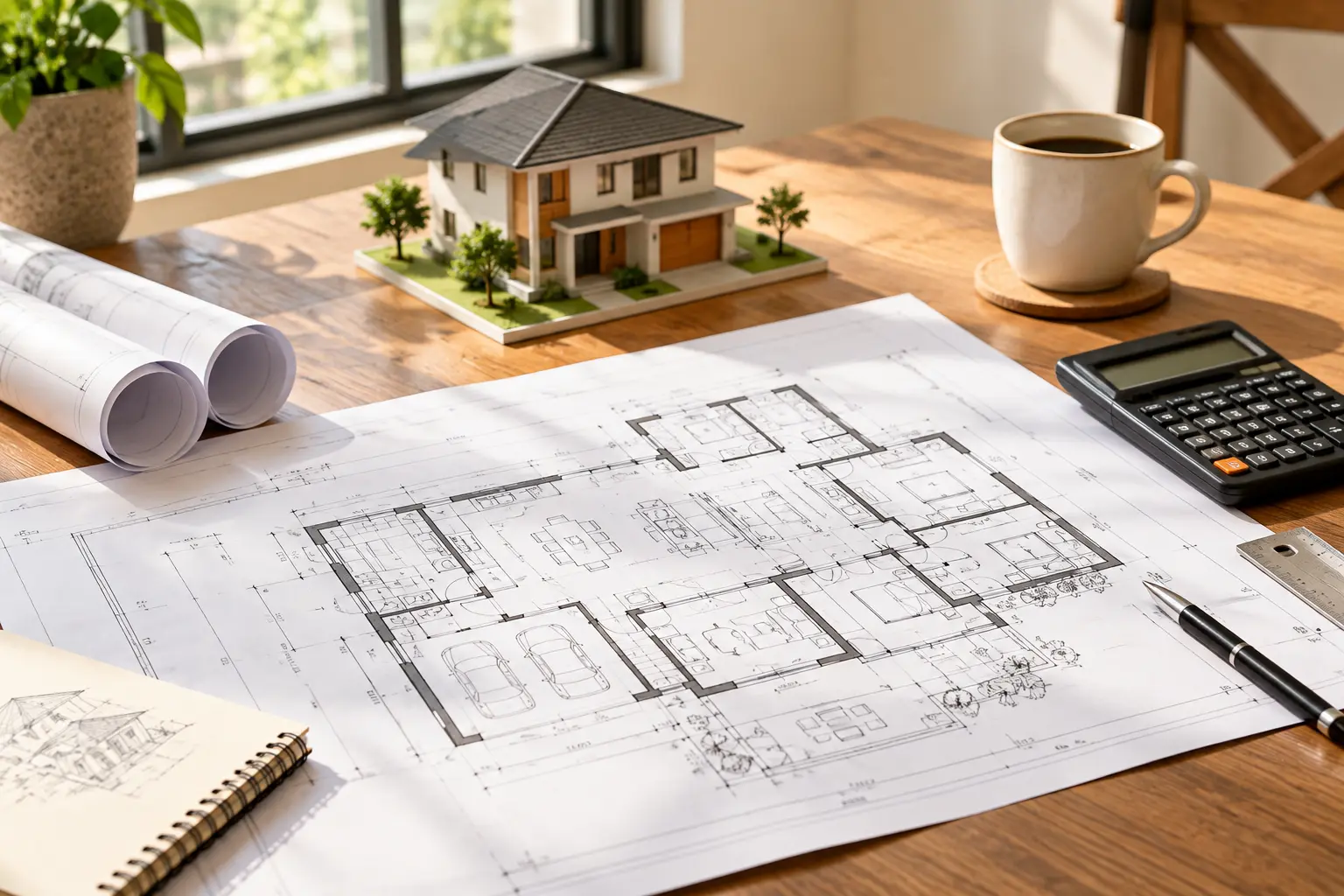
Published figures run from $150 to $600+ per square foot, and the reason for that four-fold spread is that most of them measure the same thing: hard construction costs only. Add land, site work, permits, design fees and contingency and the true all-in number lands roughly 40–50% higher. For a 2,000 square foot custom home, hard costs of $300,000 to $640,000 typically become an all-in budget of $450,000 to $900,000.
General cost information, not financial advice. Construction pricing moves with material and labor markets — get local bids before budgeting.
How much to design and build a custom home: why the numbers disagree by 4x
Search this question and you will find custom home costs quoted at $150, $200, $300, $450 and $600 per square foot within the first page of results. All of those figures are defensible. They are not describing the same thing.
Almost every per-square-foot figure is hard construction costs only. That means materials and labor for the house itself. It excludes land, site work, permits, architectural fees, financing and contingency.
Multiple sources state this explicitly, and it is the single most useful thing to understand before budgeting. A standard cost-per-square-foot figure typically covers foundation (10–15%), framing (15–18%), exterior envelope (12–16%), mechanical, electrical and plumbing (18–24%) and interior finishes (25–30%). Nothing else.
The second reason for the spread is tier. Production builds, semi-custom builds and full architect-led custom homes are different products, and they get averaged together in headline numbers.
Hard construction cost by tier
| Tier | Hard cost per sq ft | What it covers |
|---|---|---|
| Budget / production | $150–$200 | Pre-engineered plans, controlled allowances, standard ceiling heights |
| Mid-range | $200–$290 | Semi-custom plan modified by the homeowner; largest share of the market |
| Standard custom | $150–$250 | Mid-grade finishes, basic architectural detail, no specialty engineering |
| Custom (NAHB / RSMeans) | $300–$600+ | Full architect-led design, bespoke materials, longer schedule |
| High-cost urban markets | $240–$450+ | Higher labor wages, strict zoning, expensive permitting |
| Luxury | $450–$550+ | Custom cabinetry, premium stone, designer fixtures throughout |
Ranges compiled from Angi, Opendoor, NAHB and RSMeans 2026 data, and contractor pricing guides published in 2026. Hard costs only.
Custom homes cost 20–30% more per square foot than production-builder homes, because of architect fees, bespoke materials and longer timelines. A production home built from one of five to fifteen floor plans delivers 2,500 square feet for $375,000 to $500,000 in most mid-cost markets.
How much to design and build a custom home, all in
The keyword most people search asks about design and build together, and most cost guides only price the build. Here is the design half.
| Professional | Typical fee | Notes |
|---|---|---|
| Architect | 8–15% of construction cost | Or $10,000–$60,000 by size and complexity; $100–$250/hour; $2–$15/sq ft |
| General contractor | 15–25% on top of hard costs | Covers project management, insurance, warranties and business overhead — not just profit |
| Construction / project manager | 5–15% of construction | Optional; overlaps with the GC role on smaller builds |
| Permits | $1,000–$4,000 | One new-construction permit usually covers plumbing, roofing and electrical |
On a $323,000 build — the 2026 national average for a single-family home — the general contractor’s margin alone is $48,000 to $81,000. That is not pure profit: it covers project management, insurance, warranties and the cost of running the business. But it is real money and it belongs in your budget from the start.
Land and site prep are almost always quoted separately and routinely add 20 to 35% on top of the construction figure. Urban builds add impact fees and parking requirements that can exceed $25,000 on their own.
The working multiplier: take your hard construction cost and expect the all-in figure to land roughly 40 to 50% higher once land, permits, design fees and a 15% contingency are added.
A worked example
For a 2,000 square foot custom home, using published 2026 ranges:
- Hard construction cost: $300,000 to $640,000 depending on location and finish level
- Architect at 8–15%: roughly $24,000 to $96,000
- Permits: $1,000 to $4,000
- Land and site prep: 20–35% of construction, so $60,000 to $224,000
- Contingency at 15%: $45,000 to $96,000
- Realistic all-in total: $450,000 to $900,000
Furnishing is a separate line again — $30,000 to $80,000 for a 2,000 square foot home, and it arrives at exactly the point when the budget is most stretched.
Why the Census median looks so much cheaper
This comparison misleads people constantly, and it is worth resolving.
The US Census Bureau and HUD reported the median sales price of new single-family houses sold in December 2025 at $414,000. Against that, a $700,000 custom build looks extravagant.
It is not a like-for-like comparison. That median is dominated by production homes: builder-owned land bought at scale, standardized plans, volume purchasing on cabinets, windows and flooring, and repeat-build efficiencies. None of those advantages exist on a one-off custom build.
If your reference point for “what a house costs” is a new-home sales figure, you are comparing a mass-produced product to a bespoke one.
Location changes the answer more than anything else
Regional variation dwarfs almost every other variable in this calculation.
California and New York can run 2.5 times the cost of Mississippi or Arkansas. Mississippi, Arkansas, Oklahoma and Alabama are consistently the lowest-cost states, with production build costs of $100 to $160 per square foot.
Costs also vary 20 to 30% within the same state, which is why a national average is a sanity check rather than a budget. Always get local bids.
Labor is the reason. On a custom build, labor accounts for 40 to 50% of the total — an average of $330,000 to $415,000 — because everything is being done bespoke rather than repeated.
Where you can actually reduce the number
Four levers that change how much you design and build a custom home for, in rough order of impact.
Reduce square footage before reducing finish quality. Cost scales with area, and a smaller well-finished house is a better outcome than a large one with cheap fittings.
Start from an existing design. Modifying a plan your architect already holds, rather than starting from scratch, can save several thousand dollars in architect and structural engineer fees.
Simplify the form. Complex rooflines, bump-outs and unusual angles cost money at every trade — framing, roofing, envelope and finish all get harder.
Choose the site carefully. Slope, rock, drainage and utility distance are the costs that appear after you have committed, and they are invisible on a floor plan.
If renovating an existing property is another option, compare the costs of improving a small house. Our green home improvement guide can also help you evaluate energy choices while the design is still flexible.
What to ask before you commit
- Is this quote hard costs only? Ask explicitly. It usually is.
- What is your fee, and what does it cover? A GC margin of 15–25% is normal; ask for a line-item breakdown separating materials, subcontractor labor and the builder’s own fee.
- What is the allowance schedule? Two builders quoting the same total are not offering the same house if their finish allowances differ.
- What is the site work budget, separately? With its own buffer.
- How long before ground breaks? Architect-led design commonly takes 6 to 12 months before construction starts, and that timeline carries financing cost.
See our guide to designing a custom home for how allowances and change orders work once you sign, and our home improvement loan breakdown if you are financing the build.
FAQ
How much does it cost to build a 2,000 square foot custom home?
Hard construction costs run $300,000 to $640,000 depending on location and finish level. Adding land, permits, design fees and contingency takes the true all-in budget to roughly $450,000 to $900,000 in most US markets. Furnishing adds a further $30,000 to $80,000.
What do architects charge to design a custom home?
Typically 8 to 15% of construction cost, which is the most common residential billing model. Alternatives are $100 to $250 per hour, or $2 to $15 per square foot. In dollar terms, Angi puts architect fees at $10,000 to $60,000 depending on the size and complexity of the home.
Why is cost per square foot such a wide range?
Because most published figures are hard construction costs only, and because production, semi-custom and full custom builds get averaged together. Hard costs exclude land, site work, permits, architectural fees, financing and contingency, which together add roughly 40 to 50% to the total.
How much more does a custom home cost than a production home?
About 20 to 30% more per square foot, driven by architect fees, bespoke materials and longer construction timelines. A production home built from a standard plan delivers 2,500 square feet for $375,000 to $500,000 in most mid-cost markets.
How much contingency should I budget?
15% is a common planning figure and is what several 2026 all-in estimates use. On older or difficult sites, more. Contingency is what lets you resolve a discovery without stopping work or cutting scope somewhere else.
Does the national average tell me what my build will cost?
Only roughly. California and New York can run 2.5 times the cost of Mississippi or Arkansas, and costs vary 20 to 30% within a single state. Treat national figures as a sanity check and get local bids before setting a budget.