Build a home cleaning routine around three things: how fast each surface actually gets dirty, how much time you have on your worst week rather than your best, and whether your home suits batching by room or by task. Most published routines fail because they are written by people who enjoy cleaning, for people who do not.
Start your home cleaning routine with an honest time budget
Almost every home cleaning routine online is built for more time than the person reading it has.
The Bureau of Labor Statistics puts household activities at 2.8 hours a day for women and 2.1 for men on the days they do them, with 87% of women and 75% of men doing some on an average day in 2025.
That figure gets quoted constantly and it misleads here, because “household activities” includes cooking, lawn and garden care, pet care, vehicle maintenance, home repair and household admin. Cleaning is a fraction of it. Analysis of Time Use Survey data puts housework specifically at roughly 37 minutes a day, or around 226 hours a year.
Budget against 20 to 40 minutes on a weekday, not two hours. A routine built for 90 minutes a day is one you will abandon in week three, and abandoning it feels like a personal failure when it was a design error.
Write the honest number down before designing anything. Then design for your worst week — the one with a deadline, a sick child, or a trip. A routine that only works when everything goes well is not a routine.
Derive frequency from soil rate, not from a template
This is the step every published cleaning schedule skips. They hand you a daily, weekly and monthly grid without explaining how anything got assigned to a column.
The rule is simple: frequency should match how fast the surface actually gets dirty in your house, not how often a template says to clean it.
Ask two questions per area:
- What makes it dirty? Food, water, bodies, shoes, pets, or nothing.
- How many people generate that here, how often?
Kitchen counters get food on them daily, so they are daily. A guest bedroom nobody enters generates nothing, so it is monthly at most. A bathroom used by four people needs different attention from one used by one, regardless of what any checklist says.
Pets, small children or heavy outdoor traffic move several tasks up a tier. One or two adults who are out all day move several down. Both are correct.
A useful test: if a task is on your weekly list and the surface never looks dirty when you get to it, move it to every two weeks. If it always looks bad before you arrive, move it up. Two or three rounds and the routine fits your house rather than a stranger’s.
Choose your model: by room or by task
The two structures that dominate published house cleaning routines are rarely compared, and the right one depends on your home rather than your personality.
Room-per-day. Monday the kitchen, Tuesday the bathrooms, Wednesday the bedrooms, and so on. You finish each day with one visibly complete room.
Suits: multi-story homes, larger houses, anyone who finds visible progress motivating. Costs: more carrying supplies around, and repeated setup for the same task in different rooms.
Task-per-day. Monday all floors, Tuesday all bathrooms, Wednesday all dusting. You do one job everywhere at once.
Suits: single-floor homes, smaller spaces, anyone who wants to finish faster. Costs: no room ever looks entirely done on any given day, which some people find demotivating.
The deciding factor is stairs. In a multi-story house, “all floors” means hauling a vacuum up and down repeatedly and the efficiency gain disappears. On one level, task batching is meaningfully faster.
Pick one and run it three weeks before judging it. Switching models every two weeks is how people conclude that no routine works.
The build process
Six steps to build a home cleaning routine, roughly an hour of planning.
- Walk the house and list every cleaning task, room by room. Include the ones you forget — light switches, door handles, baseboards, inside the microwave.
- Assign each a frequency using the soil-rate test above. Daily, weekly, every two weeks, monthly, seasonal.
- Time the daily and weekly tasks. Actually time them. Most people overestimate how long a bathroom sink takes and underestimate a full bathroom.
- Total the weekly minutes against your honest budget. If it exceeds, something moves down a tier — the step where routines succeed or fail.
- Distribute across the week using room-per-day or task-per-day.
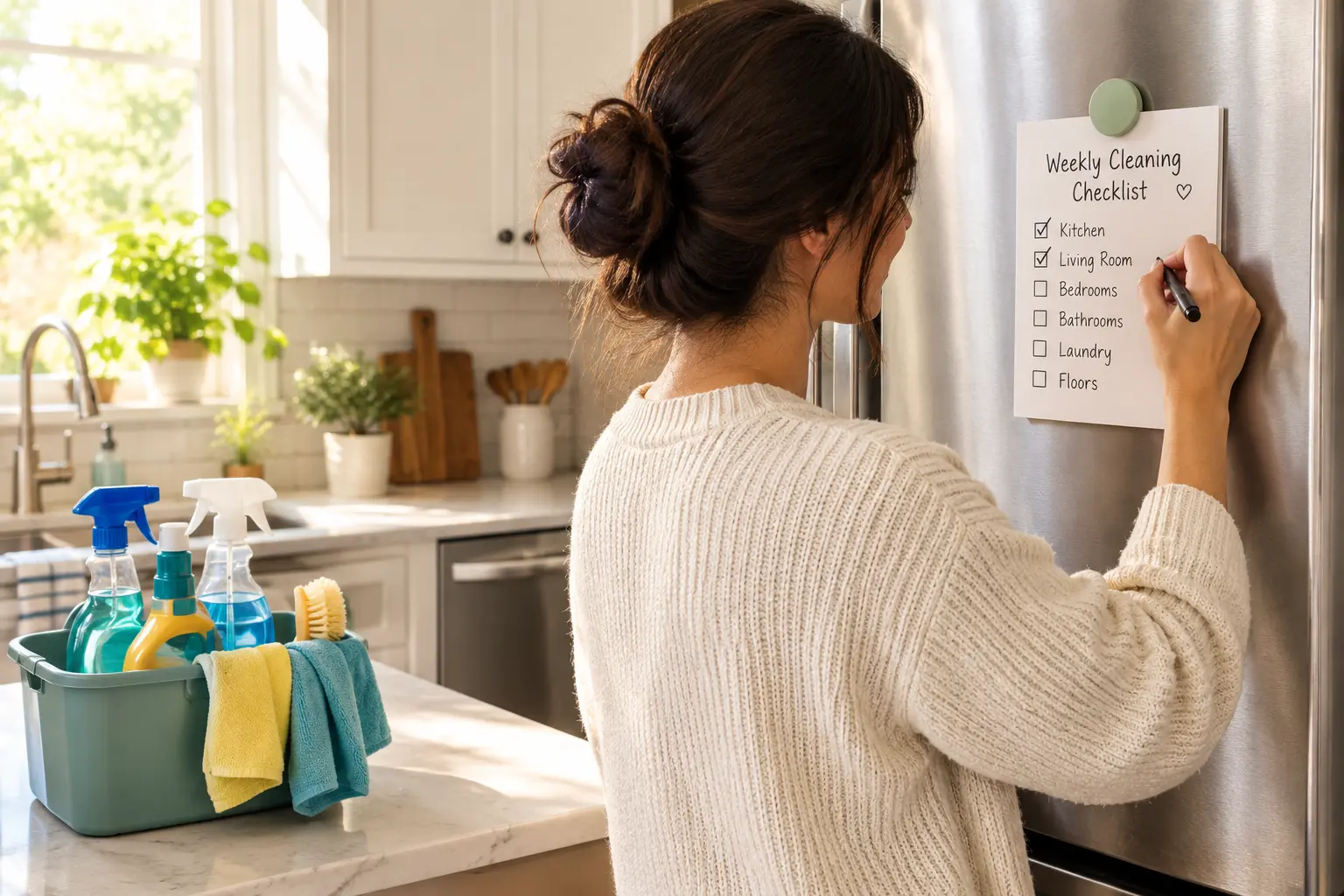
- Write it somewhere you will see it. A note on the fridge outperforms an app you have to open.
Step 4 is where most people cheat. If your list needs 90 minutes a week and you have 40, do not resolve to try harder. Move things down.
A starting framework you can adjust
Not a prescription — a default daily cleaning and weekly cleaning split to modify with the soil-rate test.
| Frequency | Typical tasks |
|---|---|
| Daily, 10–20 min | Dishes, wipe kitchen counters and sink, wipe bathroom sink, quick toilet bowl scrub, make beds, pick up clutter, sweep obvious crumbs |
| Weekly, 60–90 min total | Vacuum and mop floors, full bathroom clean including shower and mirrors, dust all rooms, change sheets and towels, empty bins, clear old food from the fridge |
| Every two weeks | Interior windows, baseboards, wipe cabinet fronts, vacuum upholstery |
| Monthly | Inside the microwave and oven, light fixtures and fans, door handles and switches, under furniture, wash shower curtain |
| Seasonal | Windows outside, curtains, mattress rotation, deep clean of appliances, decluttering pass |
Two structural additions worth making permanent.
Clean as you go. Wipe a surface right after using it and put things back when you finish. Not a task on the list — it is what stops the list growing. University extension guidance on planning cleaning routines puts this ahead of the schedule itself.
Keep supplies where they are used, plus one portable caddy. Walking to a cupboard is the friction that turns a two-minute job into a postponed one.
Match the method to the task as well as the frequency: see how to clean grease off kitchen cabinets for kitchen buildup and homemade carpet cleaning solutions for spot-cleaning and machine precautions. For recurring kitchen pests, use the separate guide to getting rid of cockroaches in the kitchen; a cleaning schedule alone is not a treatment plan.
Build in a reset, or one bad week ends it
Every routine gets missed. The ones that survive have a defined recovery mechanism. The ones that collapse do not, because a missed week becomes a backlog and the backlog becomes avoidance. Three options that work:
- A weekly catch-up slot — one hour that is either used for missed tasks or given back to you if there were none.
- The rule of one — after a missed week, do not attempt to catch up on everything. Do the single most visible task and resume the normal schedule.
- A designated rest day. Genuinely nothing scheduled. This is not laziness; it prevents the routine feeling like it has no end.
The point of a reset is that missing a week is a normal event with a normal response, not a failure that requires starting over.
Why most published routines fail
Worth naming, because it is usually why the last three attempts did not stick.
Cleaning routines online are overwhelmingly written by people with a natural knack for it — people who enjoy an organized home and are good at keeping one. Their routines are comprehensive because comprehensive is enjoyable to them. Handed to someone without that inclination, the same routine produces discouragement rather than a clean house.
If a published routine has ever left you feeling behind by week two, the routine was too big. A fixable design problem, not a character flaw.
Start smaller than feels adequate. A 15-minute daily routine you keep for a year beats a 45-minute one you abandon in a month, and the second month of a small routine is easier than the first because the house is starting from cleaner.
Adjust your home cleaning routine after three weeks
Run it as designed for three weeks without changes, then review once.
Which tasks did you consistently skip? Either they are unnecessary at that frequency, or badly placed in the week. Which areas still looked bad despite being on the list? Move those up a tier. Which took much longer than you timed? Split them.
Reviewing weekly is too often — you will react to a single bad week. Reviewing never is why routines drift out of fit as households change.
See our home cleaning guides for the methods behind each task on this page, from bathrooms to carpets.
FAQ
How much time should a home cleaning routine take each day?
Between 15 and 30 minutes on weekdays for most households, with 60 to 90 minutes weekly for deeper tasks. Time Use Survey analysis puts average housework at roughly 37 minutes a day. If your planned routine substantially exceeds your honest available time, tasks need to move down a frequency tier rather than being attempted harder.
Should I clean one room per day or one task per day?
Room-per-day suits multi-story and larger homes and gives visible completion each day. Task-per-day is faster in single-floor and smaller homes because you set up once. The practical deciding factor is stairs — carrying a vacuum between floors cancels out the efficiency of batching floors together.
How do I decide whether something is a daily, weekly or monthly task?
Match frequency to how fast it actually gets dirty in your house. Ask what soils it and how many people generate that. Kitchen counters see food daily; a spare room nobody enters does not. If a weekly task never looks dirty when you reach it, move it to every two weeks.
What should I do when I fall behind on my cleaning routine?
Do not attempt to catch up on everything. Complete the single most visible task and resume the normal schedule from that day. Building a designated catch-up slot or rest day into the routine from the start means a missed week has a defined response rather than becoming a backlog.
Why do cleaning routines never stick for me?
Usually because the routine was designed for more time and more inclination than you have. Most published routines are written by people who enjoy cleaning, which makes them comprehensive rather than sustainable. A smaller routine kept consistently outperforms a thorough one abandoned after a month.
Does a cleaning routine still work with kids or pets?
Yes, but several tasks move up a frequency tier — floors, surfaces at low height, and anything involving food or fur. The framework does not change; the frequencies do. Assigning age-appropriate tasks to household members is the other adjustment that makes the totals work.