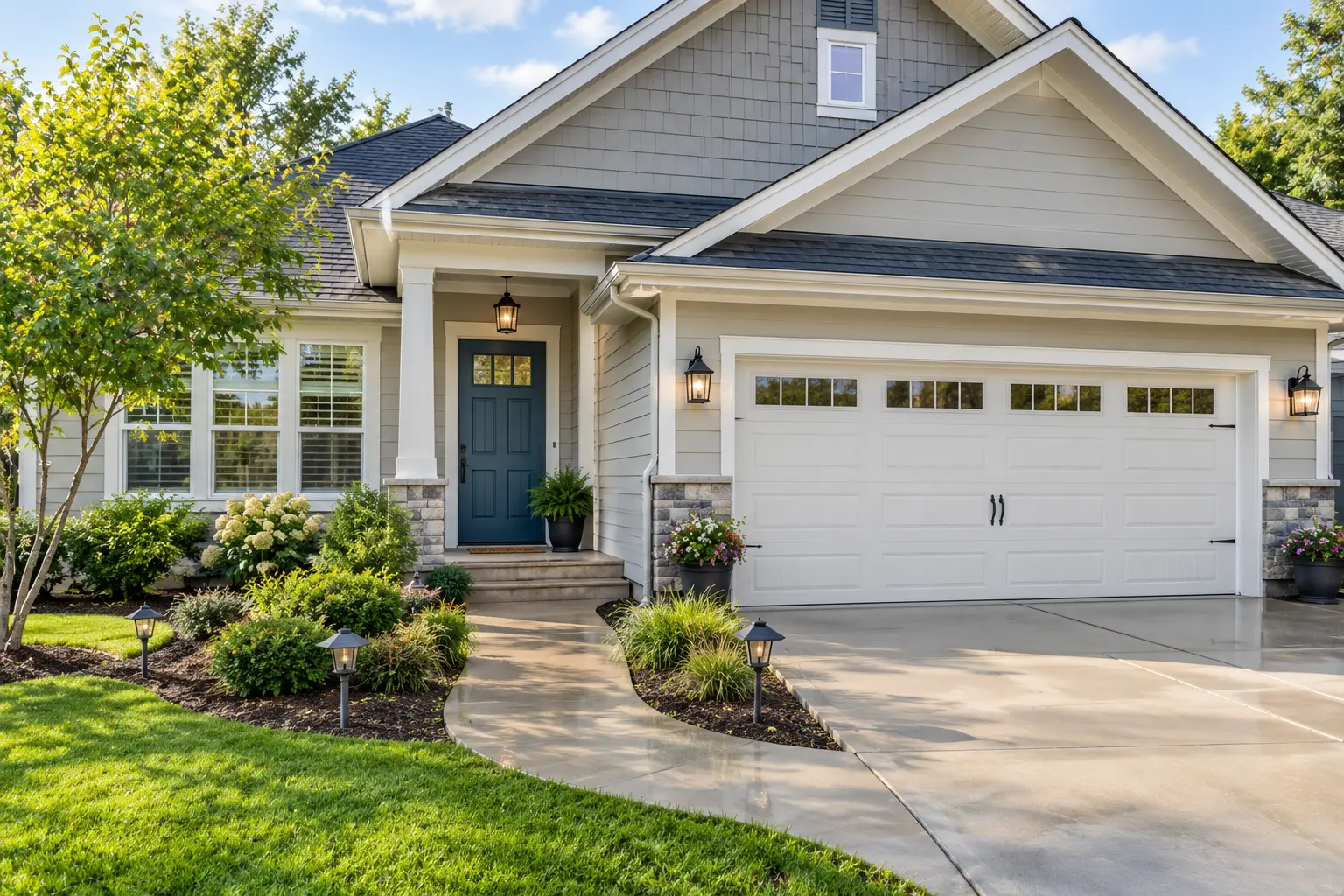
The most useful home exterior improvement tips follow one order: fix what lets water in, then replace what buyers see, then decorate. Eight of the ten highest-return home improvements nationally are exterior projects, according to the Remodeling 2025 Cost vs. Value Report. Garage door replacement leads at 268%, steel entry door at 216%, and manufactured stone veneer at 208%.
Home exterior improvement tips, in the right order
The exterior does two jobs: it keeps weather out, and it sets what a buyer believes about the rest of the house before they step inside. Curb appeal is the second job, and it is worth real money — but not before the first job is done.
Mixing the two is how people spend $4,000 on landscaping while a failed roof flashing rots the sheathing behind it. Three tiers, in this order:
- Protection — anything letting water, air or pests into the structure
- Replacement — the visible components with measurable resale return
- Cosmetic — the cheap, high-impact finishing work
Tier 3 is the most fun and the least urgent. Do it last. Most home exterior improvement tips lists invert this order because Tier 3 photographs better.
Tier 1: Fix what lets water in
Nothing on this list returns money at resale. All of it prevents four- and five-figure repairs.
- Inspect the roof once a year, from a ladder or with binoculars from across the street. Look for missing or broken shingles and tiles that lift in wind. Check the sides of the roof, not just the front.
- Check flashing at every penetration — chimney, vents, skylights, valleys. Flashing fails before shingles do, and a $300 repair left two winters becomes rotted sheathing and stained drywall.
- Clear gutters and downspouts twice a year. Blocked gutters cause fascia rot, then soffit rot, then water against the foundation.
- Check that grading slopes away from the house. Soil settling toward the foundation is one of the most common and least noticed causes of basement water.
- Re-caulk around windows and doors where the bead has cracked or pulled away. Cut the old bead out completely rather than caulking over it.
- Test the entry door seal. If you can see daylight around a closed door, air and water are getting through. Weatherstripping costs under $25 a door.
Do this in early autumn while the weather still cooperates. Far easier than discovering the problem in February.
Tier 2: The replacements that actually return money
This is where the Cost vs. Value data matters, and where most exterior home improvement ideas articles stop at “boost your curb appeal” without attaching a number to it.
| Project | National recoup (2025 CVV) | Notes |
|---|---|---|
| Garage door replacement | 268% | #1 for the second consecutive year; $4,672 average cost, $12,507 resale value |
| Steel entry door replacement | 216% | $2,435 average cost, $5,270 resale value |
| Manufactured stone veneer | 208% | Third place again; edged out vinyl siding |
| Fiber cement siding | ~114% | Durable, low maintenance, resists moisture and insects |
| Vinyl siding replacement | ~97% | Strongest performer relative to cost among siding options |
| Wood deck addition | ~95% | Composite decks return closer to 88% |
| Vinyl replacement windows | ~73% | Top 7 nationally; wood windows slightly lower |
| Asphalt roof replacement | ~65–70% | Necessary rather than profitable — see below |
Figures are national averages from the Remodeling 2025 Cost vs. Value Report, compiled from real-estate professionals across 136 metro areas. Regional variation is significant: roof replacement recoups closer to 54% in the West North Central region, while manufactured stone veneer reached 200.7% in the Middle Atlantic. Check the regional table for your area rather than the national number.
The roof is the exception. It returns the least of anything here and is still the first thing you replace when it needs it, because the alternative is water in the wall cavity, the insulation and eventually the framing. Insurers weight roof age heavily too, and many carriers discount premiums for a newer roof — which starts paying before resale enters the picture.
If siding and roof both need work and budget is limited: siding returns more (97% vinyl, 114% fiber cement) than roofing (about 68%). But an actively failing roof goes first regardless of what the return table says.
Tier 3: Cheap work that changes the first impression
None of this is tracked in resale studies, and all of it is visible from the street within five seconds.
- Repaint the front door in exterior enamel, two coats, laid flat if you can take it off the hinges.
- Replace house numbers in a finish matching the door hardware. Mismatched metals read as unplanned.
- Swap the mailbox for one that suits the architecture rather than whatever was there.
- Update entry door hardware. Smart locks are popular with buyers and take under an hour.
- Pressure wash siding, walkways and the driveway. The largest visual change per dollar on this page.
- Replace the welcome mat with something clean and plain.
- Add low-voltage landscape lighting on a timer. Plugs into an existing exterior outlet, no permit required.
- Add porch furniture matching the house style rather than filling the space with whatever is available.
One measured data point on outdoor space: Zillow’s analysis of nearly one million home sales found homes with an outdoor TV sold for 3% more — the highest premium of all 359 features it examined. Read that as a correlation with well-finished outdoor living areas, not as advice to mount a television outside.
For smaller jobs you can finish yourself, compare these budget home upgrades. Our green home improvement guide covers the energy-saving choices behind exterior work such as sealing and insulation.
The rule most exterior guides skip: bundle the work
Replacing several exterior components at once is usually cheaper than doing them one at a time.
Setup, tear-off, scaffolding, dumpster rental and mobilization get paid once instead of three times. Siding and window replacement integrate better done together, because the flashing and water management between the two systems is installed as one assembly rather than retrofitted around existing work.
The trade-off is one large bill instead of three spread across years, and less flexibility if plans change. If you are staying long term and two or more exterior systems are near end of life, bundling is the better economics.
Check this before hiring anyone for exterior work
One requirement almost no consumer article mentions, applying to a large share of US housing stock.
Any contractor disturbing painted surfaces on a home built before 1978 must hold EPA RRP certification under 40 CFR Part 745, Subpart E. That covers siding replacement, window replacement, exterior painting prep and most demolition. It is a federal requirement, not a preference, and a contractor who cannot produce it should not be scraping paint on your house.
Also verify state contractor licensing for your state specifically, liability and workers’ compensation insurance, and manufacturer certification for the exact product being installed — several siding and window manufacturers void warranty coverage on installations by uncertified installers.
A note on energy tax credits in 2026
If you are budgeting exterior work partly on efficiency grounds, one change matters.
The federal Energy Efficient Home Improvement Credit under Section 25C — up to $600 for qualifying ENERGY STAR windows and up to $250 per door — expired on 31 December 2025. Improvements placed in service during 2026 are not eligible.
State and utility programs still exist in many areas and are worth checking before assuming a project costs full price. The savings themselves remain: the Department of Energy attributes a 25–30% reduction in annual heating and cooling costs to low-E glass, with the largest gains in homes replacing single-pane windows.
Where to start with these home exterior improvement tips
Take the sequence rather than any individual project.
Walk the perimeter of the house this weekend. Look at the roof from the street, check the gutters, look at where the ground meets the foundation, and press on any wood trim that looks dark. Everything you find belongs in Tier 1. Everything you were already planning belongs in Tier 2 or 3, and it can wait a season.
See our guide to beginner-friendly DIY projects and the tool kit that covers most of them, so the Tier 1 work does not need a contractor.
FAQ
What exterior home improvement adds the most value?
Garage door replacement, at 268% national recoup in the Remodeling 2025 Cost vs. Value Report, with an average cost of $4,672 against $12,507 in added resale value. Steel entry door replacement follows at 216% and manufactured stone veneer at 208%. All three are visible from the street, which is the pattern behind the ranking.
Should I replace siding or the roof first?
Siding returns more of its cost — about 97% for vinyl and 114% for fiber cement, against roughly 68% for asphalt roofing. But if the roof is actively leaking, it goes first regardless. Return figures decide the order between two optional projects, not between an optional one and a failing one.
Is a roof replacement worth it for resale value?
On resale alone, no — it recoups roughly 65–70% nationally and closer to 54% in some regions. The case for it is elsewhere: preventing structural water damage, lower insurance premiums for a newer roof, and removing an inspection objection that can delay or reprice a sale.
What is the cheapest exterior improvement with the biggest visual impact?
Pressure washing, followed by painting the front door. Neither appears in resale studies because neither is a tracked project, but both change what the house communicates from the street for a cost measured in tens of dollars rather than thousands.
Do exterior projects really beat interior remodels for value?
Consistently. Eight of the ten highest-return projects nationally in the 2025 Cost vs. Value Report are exterior. Zonda’s own framing is that exterior work drives value for owners who are selling, while interior projects make more sense for those staying put.
When is the best time of year for exterior work?
Early autumn for inspection and small repairs, while weather still permits access. For replacement work, most exterior trades are booked heaviest between late spring and early autumn, so scheduling in the off season often means better contractor availability and occasionally better pricing.