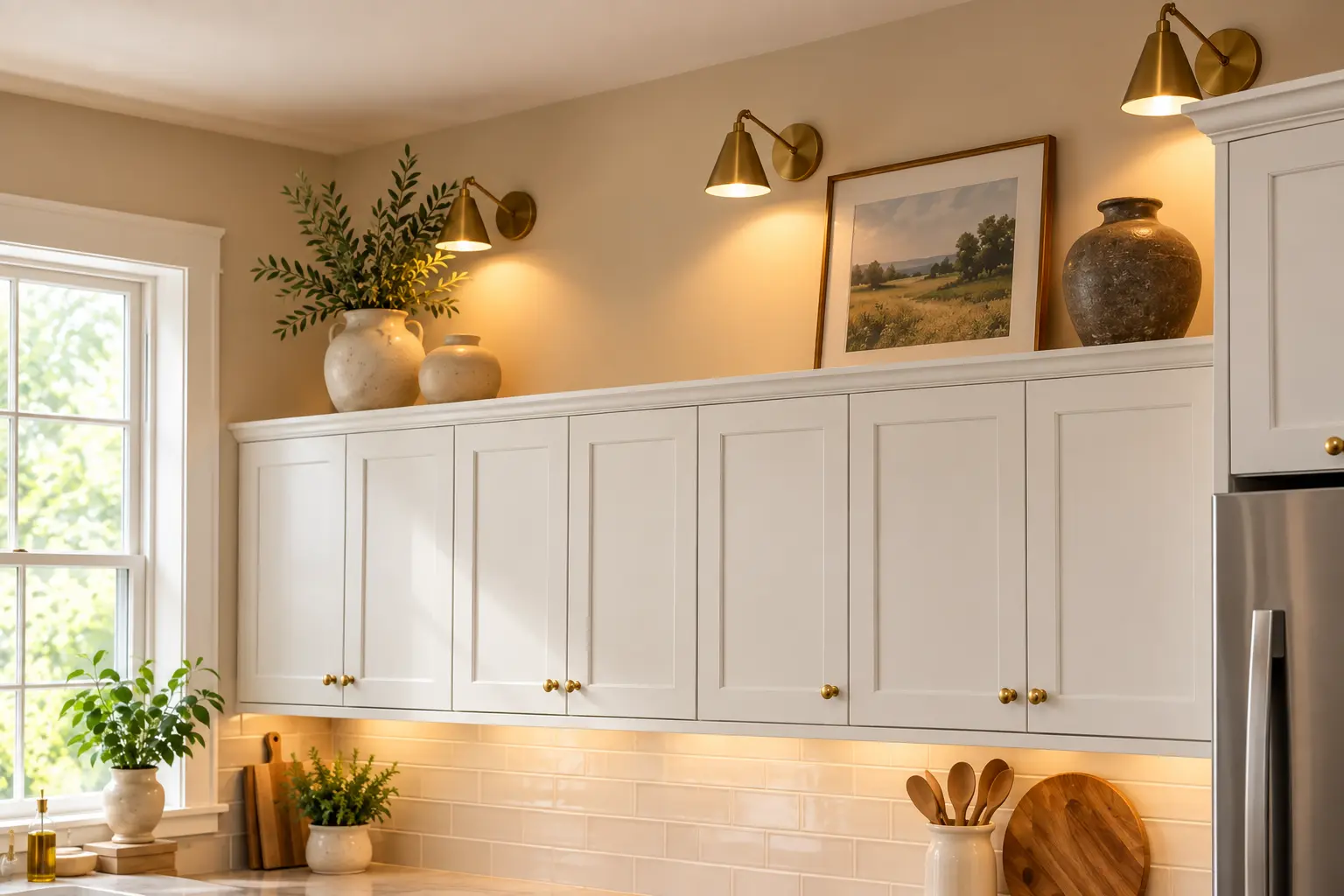
Decide whether to decorate the gap at all before you buy anything for it. Three options exist — decorate it, close it with a soffit, or extend the cabinets to the ceiling — and most designers now favor closing it, because the space creates dark voids and everything placed there collects greasy dust. If you do decorate, the modern approach is a few large pieces with breathing room, not a row of small ones.
How to decorate above kitchen cabinets — or whether to at all
Most guides on this topic answer only half the question. One offers twenty-five decorating ideas; another shows you how to build a soffit to make the gap disappear. Both are valid, and they are answers to different decisions.
| Option | Best when | Trade-off |
|---|---|---|
| Decorate it | The gap is 12 in or more, ceilings are high, and you want warmth and personality | Everything you put up there collects greasy dust |
| Close the gap | You want a clean, streamlined kitchen, or the gap is under about 12 in | Costs money and, for a real soffit, needs checking first |
| Extend cabinets to the ceiling | You need the storage and are already replacing cabinetry | The top shelf is only reachable with a step stool |
What designers actually recommend is worth knowing before you commit. Interior designers interviewed on this subject lean toward closing the gap rather than filling it with objects. One founder describes the issue plainly: the space above kitchen cabinets creates dark voids. A design director on another project built a soffit specifically because she wanted the cabinetry to feel clean and consistent, and the room to have a sense of purpose and harmony.
That is the opposite of the twenty-five-ideas approach, and neither position gets presented alongside the other. If your instinct is that the gap looks unfinished, closing it is a legitimate answer rather than a failure of imagination.
The dust problem, stated honestly
This is the practical argument, and every source mentions it in passing without ever making it plainly.
The space above your cabinets collects airborne cooking grease as well as ordinary dust. The two combine into a film that is far harder to clean than dust alone, and because the space sits above eye level you do not see it accumulating. You notice it when it has already gone fuzzy.
Everything you put up there has to come down and be washed on a schedule. Objects with detail — woven baskets, foliage, anything textured — are the worst offenders, because grease settles into the texture and does not wipe off.
This is the strongest single argument for closing the gap, and it is why designers who have lived with both keep choosing the soffit.
For grease on the cabinet surfaces themselves, follow our kitchen cabinet cleaning guide. Before selecting decorative objects, use the home design style quiz to make the finish and overall look feel consistent.
How to decorate above kitchen cabinets without dating your kitchen
If you are decorating above kitchen cabinets, the difference between current and dated is not what you use. It is scale and quantity.
What reads as 1990s: a lonely silk ivy trailing into space, a collection of ceramic figures gathering greasy dust, a jumble of mismatched baskets. One designer describes a client who started storing cereal boxes up there — the result looked like a supermarket aisle.
The rules that read as current:
- Fewer, larger pieces. One oversized vessel beats five small ones. Small objects at that height read as clutter because you cannot see them properly.
- Leave negative space. A continuous row along the whole cabinet run is what makes it look like storage. Gaps make it look like a decision.
- Group in odd numbers, clustered rather than evenly spaced.
- Vary height and texture within a group — something tall, something round, something flat.
- Keep the palette tight, ideally pulling from something already in the room.
- Nothing functional. The moment real food or real storage goes up there, the space reads as overflow rather than design.
What works well: large vessels and vases, stacked books laid flat, a leaned piece of art, oversized bowls, and greenery that looks convincing at a distance.
Lighting is the strongest option nobody starts with
If you want the gap to look deliberate with the least effort, light it rather than fill it. This is the cheapest way to decorate above kitchen cabinets and the easiest to live with.
Sconces along the cabinet run turn the awkward gap into an architectural feature. Oversized swing-arm sconces flanking the range make a statement; a series of smaller spotlight sconces across the length of the uppers achieves the same effect more quietly.
Choose the finish deliberately. A finish that contrasts with the cabinet and wall color draws the eye and makes the space read as intentional. A finish matching your cabinet hardware makes it recede into the design.
LED strip lighting sitting on top of the cabinets is the cheapest version. It washes the ceiling with light, makes the room feel taller, and collects far less dust than objects do because there is nothing to settle on.
Closing the gap: what to check first
If you decide to eliminate the space, there is a check to do before anything else.
Find out what is behind an existing soffit. Older homes often have boxy panels above the cabinets that hide pipes from an upstairs bathroom, electrical wiring or ductwork. Frequently there is nothing behind them at all — they exist only to fill space. But some soffits are structurally necessary and should only be modified by a professional.
If it hides HVAC ducts, you can still clad it in decorative material or build storage around it, provided access points stay unobstructed for maintenance.
Building a new soffit is a realistic DIY project. Plywood or offcuts of drywall, fixed with a brad nailer or construction adhesive, then finished with crown molding on the face to tie it into the cabinetry. Expect to work around existing wiring, heat ducts and air conditioning.
Two upgrades worth building in: LED strip lighting inside the soffit, and — if the depth allows — shallow storage for the seasonal items you use twice a year.
The third option most people miss
There is a version that solves the gap and gains storage at the same time.
Move the upper cabinets up to meet the ceiling, then install open shelving in the space that opens up beneath them. You get the clean full-height line, and the new shelf sits at a height you can actually reach — which is where decorative objects and everyday dishware belong anyway.
This only makes sense if you are already replacing or refitting cabinetry, since it means removing and rehanging the uppers. But if a kitchen refresh is on the cards, it is the option that turns dead space into usable space rather than into decoration.
A smaller version: if the gap is only a few inches, running trim along the top of the uppers closes it entirely for very little money, produces a built-in look, and removes the dust ledge in one move.
See our guide to modernizing oak cabinets if the cabinets themselves are the dated element, and our kitchen organization guide for the storage this space is often standing in for.
FAQ
Is decorating above kitchen cabinets outdated?
The practice is not, but the 1990s execution is — trailing silk ivy, ceramic collections and mismatched baskets. The current approach uses fewer, larger pieces with negative space between them. Many designers now prefer closing the gap with a soffit instead of decorating it at all.
What should I put above my kitchen cabinets?
Large vessels and vases, books stacked flat, a leaned piece of art, oversized bowls, or convincing greenery — grouped in odd numbers with gaps between clusters. Avoid small objects, continuous rows, and anything functional, since real storage up there reads as overflow.
Should I fill the gap above my kitchen cabinets?
Often, yes. Designers describe the space as creating dark voids, and a soffit gives a cleaner, more consistent line. It also removes the dust ledge. If the gap is under about 12 inches, filling it with trim or a soffit almost always looks better than decorating it.
How do I stop things above my cabinets getting dusty?
You cannot, entirely. The space collects airborne cooking grease as well as dust, which combine into a film that is harder to clean than dust alone. Choose smooth objects over textured ones, plan to wash them on a schedule, or close the gap so there is no ledge.
Can I remove a kitchen soffit myself?
Only after checking what is inside it. Many hide plumbing from an upstairs bathroom, wiring or ductwork, and some are structurally necessary and should only be modified by a professional. If it conceals HVAC ducts, keep access points unobstructed.
What is the cheapest way to deal with the space above cabinets?
LED strip lighting laid on top of the cabinets, which washes the ceiling, makes the room feel taller and collects almost no dust. For a small gap, running trim along the top of the uppers closes it for very little money and creates a built-in look.