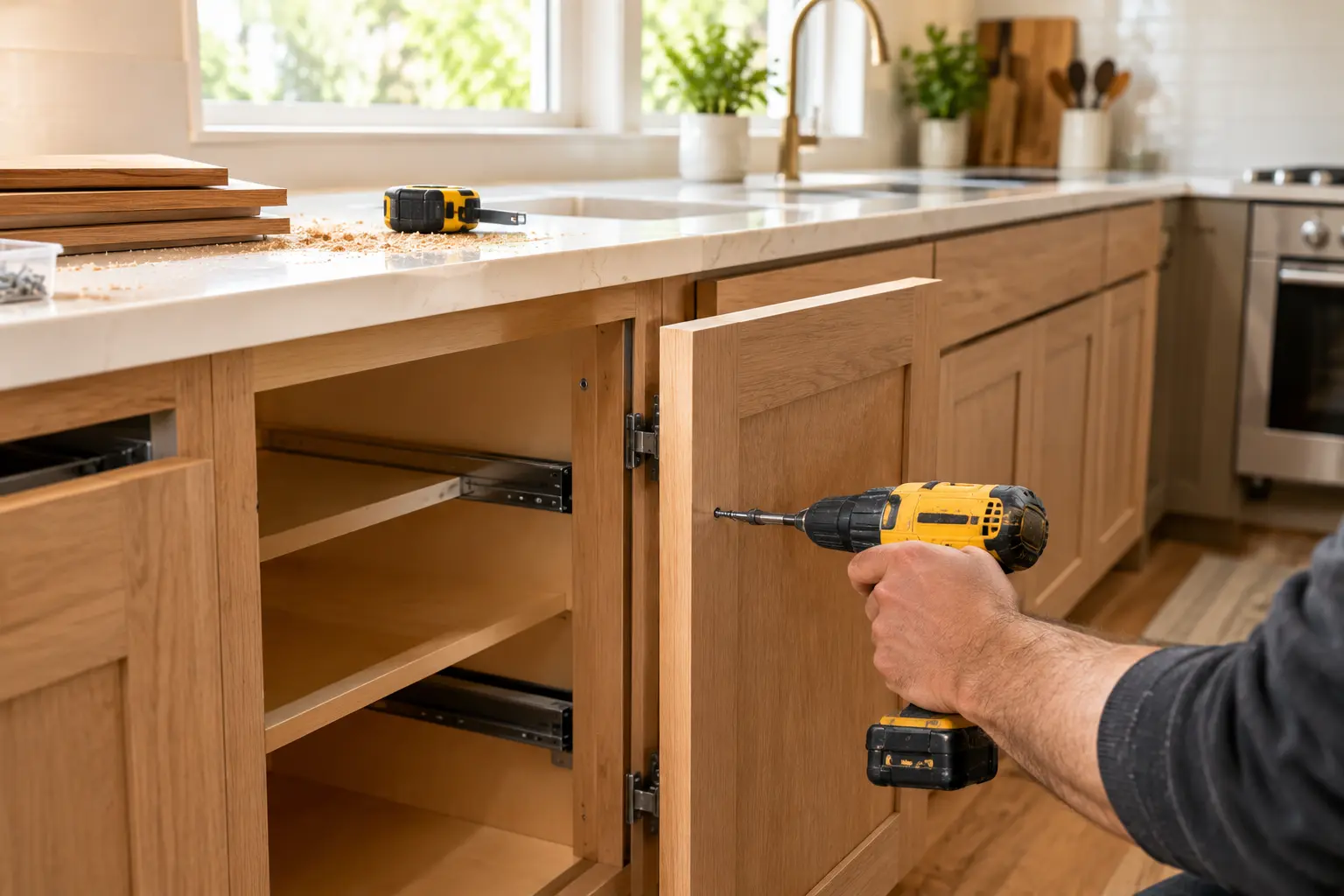
Typical projects run $4,000 to $12,000, with a national average around $7,500. Published per-linear-foot figures range from $100 to $1,000 — a tenfold spread — because some quote materials only and others quote everything installed. The material you choose sets the bracket, and cabinet interiors are almost never included.
General cost information, not financial advice. Refacing prices vary sharply by material and region — collect at least three itemized bids.
Last updated: September 2026
How much does it cost to reface kitchen cabinets? Why quotes vary tenfold
Published per-linear-foot figures for this job span $100 to $1,000. That is not sloppiness — they are measuring different scopes.
- $50–$150 per linear foot is materials only
- $150–$450 per linear foot is the range most professionals quote, materials plus labor
- $400–$1,000 per linear foot is fully installed with end panels, crown molding, soft-close hardware and disposal included
Total project figures cluster more tightly. Most refacing jobs land between $4,000 and $12,000, with a national average near $7,500. Budget projects start around $2,000; premium work reaches $20,000. One 20-linear-foot kitchen quoted fully installed can run $8,000 to $20,000 depending on tier.
Before comparing two quotes, establish which of those three scopes each one describes. That single question resolves most of the apparent difference.
Material sets the bracket
Your material choice is the largest variable in the quote, and the differences are more than cosmetic.
| Material | Per linear foot | Durability | Refinishable later? |
|---|---|---|---|
| Rigid thermofoil / laminate | $50–$150 | Shortest — peels, especially with moisture | No |
| Wood veneer | $100–$300 | Middle — can separate over time | No |
| Solid wood doors, veneered boxes | $150–$500 | Longest — best against water and humidity | Yes |
| High-grade woods (cherry, walnut) | $200–$500 installed | Longest | Yes |
The thermofoil warning is worth taking seriously. One cost guide describes laminates as vinyl siding for kitchen cabinets — affordable, easy to clean, available in many colors, and best treated as temporary rather than durable. Most contractors will warn against using it.
In humid climates the warning gets sharper. Homeowners in high-humidity regions such as the Southeast are reported to be seeing roughly 15% higher peeling failure rates within five years on cheap thermofoil compared with wood veneer. If you live somewhere humid, the cheapest material is the one most likely to need doing again.
Placement matters too. Veneers and laminates fitted close to a stove or another source of steam can buckle prematurely, whichever material you choose. Ask your installer about the runs nearest the range and dishwasher specifically.
The refinishing point decides the long game. Solid wood can be sanded and refinished years later. Veneer and laminate cannot — when the finish fails, the surface is replaced. That is why solid wood costs more per linear foot and less per decade.
What the quote actually covers
This is the most useful thing to get right, and the reason two refacing quotes on the same kitchen can differ by thousands.
| Usually included | Often extra | Never included |
|---|---|---|
| New doors and drawer fronts | End panels, refrigerator panels, island backs | Cabinet interiors — adds $500–$2,000 |
| Veneer or laminate on visible box surfaces | Crown molding, toe kicks, light rail | Any layout change |
| New hinges and hardware | Soft-close upgrades, drawer slides | New sink or appliance openings |
| Removal, disposal and installation | Covering old hardware holes | Cabinet height changes |
Ask specifically whether the price includes: new doors, drawer fronts, veneers, end panels, hinges, drawer slides, knobs and pulls, crown molding, toe kicks, light rail, removal, disposal, prep work, installation and touch-up. A quote missing four of those is not cheaper — it is smaller.
Cabinet interiors are the most common surprise. Refacing addresses visible exterior surfaces; the insides of the boxes are usually left untouched. If yours are stained or dated, adding veneer or paint inside adds $500 to $2,000 depending on kitchen size.
Nothing about the layout changes. Sink location, appliance openings, cabinet height, island shape and storage configuration all stay exactly as they are. If any of those is your actual problem, refacing does not solve it.
The prerequisite that decides whether refacing is possible
Refacing keeps your existing boxes, which means the boxes have to be worth keeping.
They must be solid, square and dry. Water damage, sagging shelves, failing joints or out-of-square carcasses are replacement territory, not refacing territory. A contractor who agrees to reface failing boxes is selling you a finish over a problem.
There is a middle option for boxes that are merely weak. Poor-quality cabinets can be strengthened with a quarter-inch sheet of good plywood before laminate or veneer goes on. That adds cost, varying with condition, but it can rescue cabinets that would otherwise fail the test.
DIY refacing: the honest arithmetic
Labor on a professional reface averages $4,125 to $5,775, and labor accounts for roughly 50 to 70% of the total bill. So the DIY saving is genuinely large.
The catch is skill, not effort. Refacing is an exact process with little room for error — measurements have to be right, veneer has to be applied without bubbles, and doors have to hang square. Small mistakes will not ruin the cabinets, but they will show, and they reduce the value of the work. A poor DIY reface frequently ends in paying a professional to correct it, which costs more than hiring one at the start.
Where DIY makes most sense: plastic laminate, which wraps around corners easily and is the most forgiving material to install. Where it makes least sense: wood veneer on a large kitchen, where a visible seam or bubble is permanent.
For reference, professionals charge roughly $7 to $8 per door simply to remove the old doors — a useful sense of how granular refacing pricing gets.
The cost to reface kitchen cabinets against the alternatives
Refacing sits between refinishing and replacing, and the case for it is specific.
- Painting: $2,000–$6,500, five to ten year lifespan. Cheapest, keeps your existing doors and their profile.
- Refacing: $4,000–$12,000, new doors and drawer fronts, 15 to 20 year lifespan. Changes the door profile, which is what usually dates a kitchen.
- Replacement: $14,000–$28,000+. The only option that changes the layout.
The decision comes down to two questions. Are the boxes sound, and does the layout work? Two yeses point to refacing or painting. A no to either points to replacement, and no amount of new veneer will change that.
Refacing also has a genuine environmental argument: reusing the existing carcasses avoids the material waste of a full rip-out.
Before choosing refacing, compare new kitchen cabinet costs with cabinet painting costs. Cleaning the existing finish is a separate first step; our cabinet grease-removal guide explains the material precautions.
See our cabinet cost guide for full replacement pricing, and our cabinet painting cost breakdown if the doors themselves are fine.
FAQ
What is the average cost to reface kitchen cabinets?
Around $7,500 nationally, with most projects between $4,000 and $12,000. Budget jobs start near $2,000 and premium work can reach $20,000. Professionals typically quote $150 to $450 per linear foot for materials and labor.
Why do refacing quotes vary so much per linear foot?
Because they measure different scopes. $50 to $150 is materials only, $150 to $450 is materials plus labor, and $400 to $1,000 is fully installed with end panels, crown molding, soft-close hardware and disposal. Establish which scope a quote describes before comparing it to another.
Is thermofoil a good choice for cabinet refacing?
It is the cheapest and the least durable, and most contractors advise against it. It peels over time, particularly with moisture exposure, and homeowners in high-humidity regions report around 15% higher failure rates within five years compared with wood veneer.
Does refacing include the inside of cabinets?
No. Refacing covers visible exterior surfaces, and the box interiors are usually left as they are. Adding veneer or paint inside adds $500 to $2,000 depending on kitchen size, and it is the most common surprise on a refacing invoice.
Can I reface kitchen cabinets myself?
Yes, and the saving is real since labor averages $4,125 to $5,775. But refacing is an exact process with little tolerance for error, and mistakes show permanently. Plastic laminate is the most forgiving material for DIY; wood veneer on a large kitchen is the least.
When should I replace instead of reface?
When the boxes are not sound — water damage, sagging shelves, failing joints or out-of-square carcasses — or when the layout itself is the problem. Refacing changes surfaces and doors only. Sink position, appliance openings and cabinet heights stay exactly as they are.